Choosing a sign for your business is not as simple as picking a style you like. The sign type, format, and material need to match how customers will find and approach your location, what the sign needs to communicate, and the conditions it will face in its installation environment. Getting these decisions right before ordering saves time and helps ensure the finished sign does the job it was specced for.
This guide focuses on how to match the right sign type to your business situation. For advice on evaluating sign providers, see our guide on how to choose the right sign company in San Antonio.
What Does Your Sign Need to Accomplish?
Every signage decision starts with purpose. A sign that needs to identify a business from a moving vehicle on a busy road has different requirements from one that needs to direct visitors once they are inside a building. Before choosing a sign type, be clear about what the sign is intended to do.
Common purposes include:
- Identifying the business from the road or surrounding area
- Helping customers find the entrance, parking, or specific departments once on site
- Communicating a promotion, event, or time-limited offer
- Reinforcing brand identity inside or outside the business location
- Meeting accessibility or compliance requirements
One sign rarely accomplishes all of these at once. Most businesses need a combination of sign types, each handling a specific communication task at a specific point in the customer journey.
How Will Customers Encounter Your Sign?

The viewing context determines which sign formats are practical. The two main variables are viewing distance and approach speed.
Vehicle traffic at higher speeds
Businesses on arterial roads and commercial corridors where customers approach by vehicle need signs that are visible and readable before a driver reaches the location. This typically requires larger sign formats, high contrast between text and background, and a limited amount of information on the face. Pylon signs, monument signs, and large building-mounted signs are commonly used for this purpose.
Pedestrian and slow-moving traffic
Businesses in walkable areas or shopping centers where customers approach on foot or at low speed can use smaller sign formats with more detail, because viewers have more time to read. Storefront signs, window graphics, and smaller building-mounted panels work well in these contexts.
Interior environments
Once a customer is inside the building, the sign’s job shifts from identification to navigation and brand reinforcement. Interior signage including lobby signs, wayfinding panels, and room identification needs to be clear at close range and consistent with the overall brand identity the customer encountered outside.
Exterior Sign Types and When to Use Each

Building-mounted and storefront signs
These are mounted directly on the building facade above or beside the entrance. They are the primary identification sign for most retail, restaurant, and office businesses with direct street access. The format can range from flat panel signs to 3-dimensional letters and logos to cabinet signs depending on the building, the brand, and any landlord or zoning requirements.
Monument signs
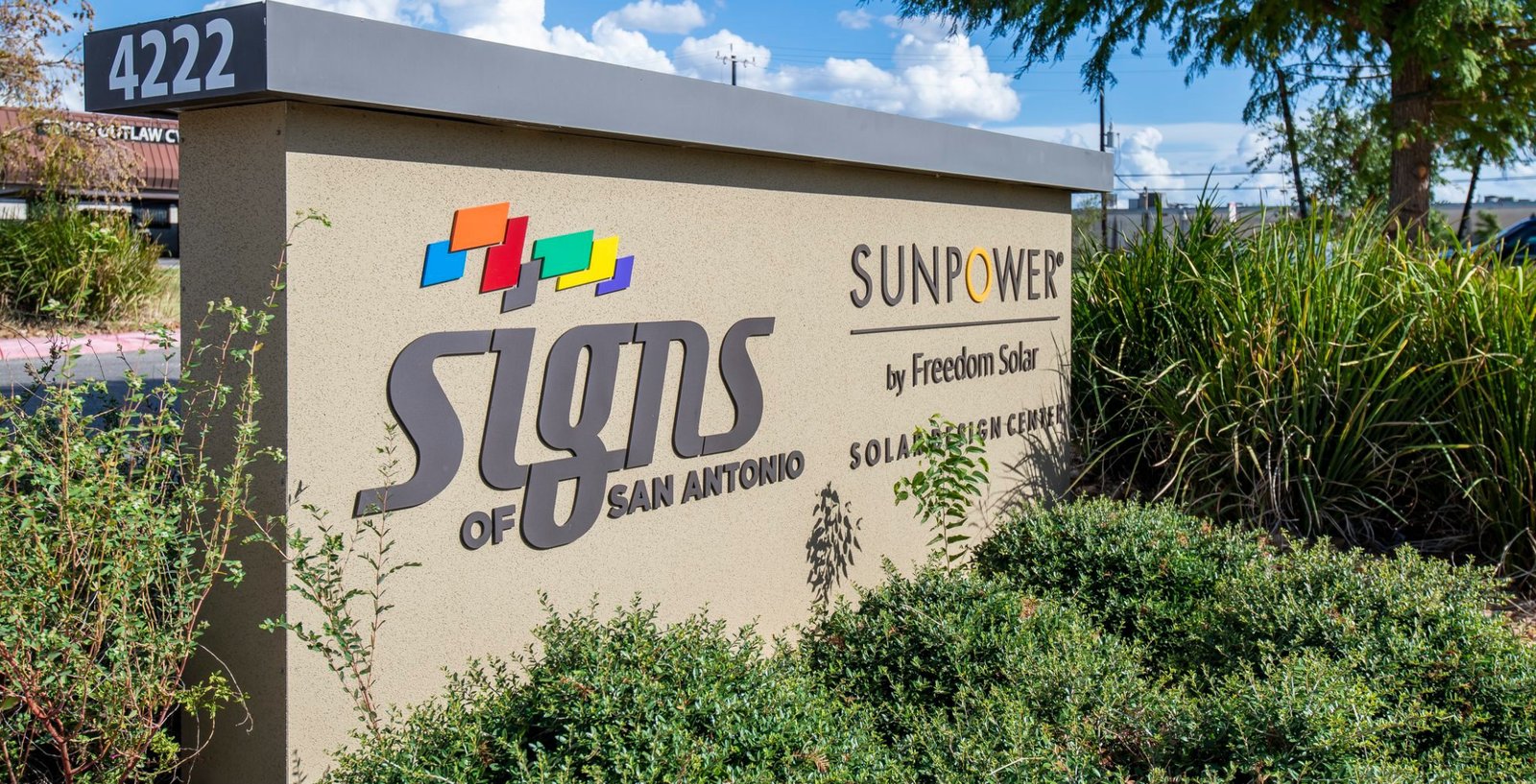
Low-profile ground-level signs positioned at a property entrance or roadside. Commonly used by businesses set back from the road, office parks, medical campuses, and multi-tenant commercial properties where the building itself is not immediately visible from the street. Monument signs help customers identify the property before they reach the building.
Pylon and pole signs
Tall freestanding signs designed for visibility from a distance along major roads. Appropriate for businesses where customers need to see the sign from a significant distance before slowing down or turning. Shopping centers, gas stations, hotels, and businesses adjacent to highways commonly use pylon signs.
Illuminated and LED signs
Any sign that needs to remain visible and readable after dark or in low-light conditions benefits from illumination. Electrical and LED signs include internally lit channel letters, LED cabinet faces, and neon flex. Illumination is worth considering for businesses that operate into the evening, are located where natural ambient light is limited, or want to maintain visibility during overcast weather.
Banners and temporary signs
Vinyl banners are suited to campaigns with a defined time period: grand openings, seasonal promotions, events, and construction site identification. They go up and come down without permanent hardware and can be produced quickly when timing is tight. Material specification should reflect the duration and conditions of the installation.
Interior Sign Types and When to Use Each
Lobby and reception signs
The primary brand statement inside the building, typically positioned behind the reception desk or at the building entrance. These signs are seen by every visitor and client and communicate professionalism and brand identity at close range. Acrylic, metal, and dimensional lettering are commonly used materials.
Wayfinding and directional signs
Signs that help people move through a space independently. Room identification, floor directories, restroom signs, and departmental directional panels all fall into this category. Well-planned wayfinding reduces confusion and the need for staff to redirect visitors. For businesses with accessibility requirements, tactile and Braille-compliant ADA signs are typically required alongside standard wayfinding.
Window and glass graphics
Applied to the inside or outside of glass surfaces, window decals and graphics serve multiple purposes: communicating business hours and contact information, promoting current offers, creating visual privacy in offices and treatment rooms, and adding branded visual presence to an otherwise plain glass facade.
Signs That Extend Brand Visibility Beyond the Location
Vehicle graphics and wraps
For businesses that use vehicles, vehicle graphics and car wraps extend brand visibility beyond the physical location. Service businesses, delivery operations, and any company whose vehicles are regularly parked or driven in areas where customers are present benefit from graphics that make each vehicle a mobile brand touchpoint.
MDO and site boards
For construction companies, contractors, and commercial real estate operations, MDO sign boards provide professional outdoor identification for project sites and leasing locations. The repaintable surface makes them practical when messaging needs to be updated across a project’s duration.
What Factors Should Influence Material Choice?
Once the sign type is determined, material selection depends on the installation context. Key factors include:
- Indoor vs. outdoor: outdoor signs need materials and finishes rated for weather exposure, including UV from direct sun, moisture, and temperature variation across seasons.
- Duration: a permanent building sign warrants more durable materials than a campaign banner or temporary site board. Matching material quality to expected lifespan avoids both under-specification and unnecessary cost.
- Viewing distance and surface requirements: signs read at close range allow finer detail and smaller text. Signs read at distance need larger text, simpler layouts, and high contrast.
- Illumination: if the sign will be internally lit, the face material needs to be compatible with backlighting. Translucent substrates like Lexan are used for backlit applications; standard solid panels are not.
- Landlord and zoning requirements: some properties and zoning designations restrict sign size, lighting, and material type. These constraints should be identified before finalizing any sign specification.
Planning the Full Signage System
Most businesses need more than one sign. An effective signage system coordinates across all the points where a customer encounters the brand: from the road, at the entrance, inside the building, and through any vehicle or off-site presence.
Planning these together rather than ordering signs separately as needs arise produces a more consistent result. Brand identity, color values, and typefaces should remain consistent across every sign type, whether it is an outdoor pylon sign or an interior lobby panel.
For businesses preparing to open, our essential signage checklist for new businesses covers the sign types most businesses need before opening day and the planning timeline required for each.
To discuss the right sign types for your San Antonio business, contact Signs of San Antonio for a quote.
Frequently Asked Questions
- How do I know which sign type is right for my business?
Start with how customers will find and approach your location, and what the sign needs to communicate at each stage of that journey. A business on a high-speed road needs signs designed for long-distance readability. A business in a walkable area can work with smaller formats at closer range. Once the purpose and viewing context are clear, the appropriate sign types follow logically. - Do I need a permit for my business sign in San Antonio?
Many permanent exterior signs require a permit from the City of San Antonio’s Development Services Department before installation. Requirements depend on the sign’s size, type, placement, and whether it includes illumination. A sign company experienced with local permitting can help manage this process and can help reduce delays associated with applications and reviews. - What is the difference between a monument sign and a pylon sign?
Monument signs are low-profile structures positioned close to ground level, typically at a property entrance. Pylon signs are tall freestanding structures designed for visibility from greater distances along major roads. The right choice depends on the viewing distance required and the speed at which customers are likely to approach the location. - When does a business sign need illumination?
Illumination is worth considering when the business operates into the evening, when the installation location receives limited natural ambient light, or when the sign needs to remain visible during overcast or low-light conditions. It is not always necessary, and adding illumination increases both production and installation cost, so the decision should be based on the specific visibility requirements of the location. - How do I keep my signage consistent across multiple formats?
Use the same logo file, color specifications, and typefaces across all sign types, and work with a provider who can produce different formats to the same brand standard. Inconsistency across sign types is often a result of ordering different formats from different vendors at different times without a coordinating brand reference. - What sign types work best for a new business opening?
The most common priorities for a new business opening are a primary exterior identification sign, interior wayfinding for customers once they are inside, and a grand opening banner for the launch period. The specific types depend on the location and building. Our new business signage checklist covers each category in more detail.